
Towards embedded evaluations for AI monitoring
Six claims for testing whether AI monitors would catch a rogue internal deployment at frontier labs: coverage, capability, trust, disclosure and what’s next.
Independent testing
Independent evaluators work inside frontier AI developers, testing their safety claims with employee-like access across training, evaluation, and internal deployment.

Why embedded
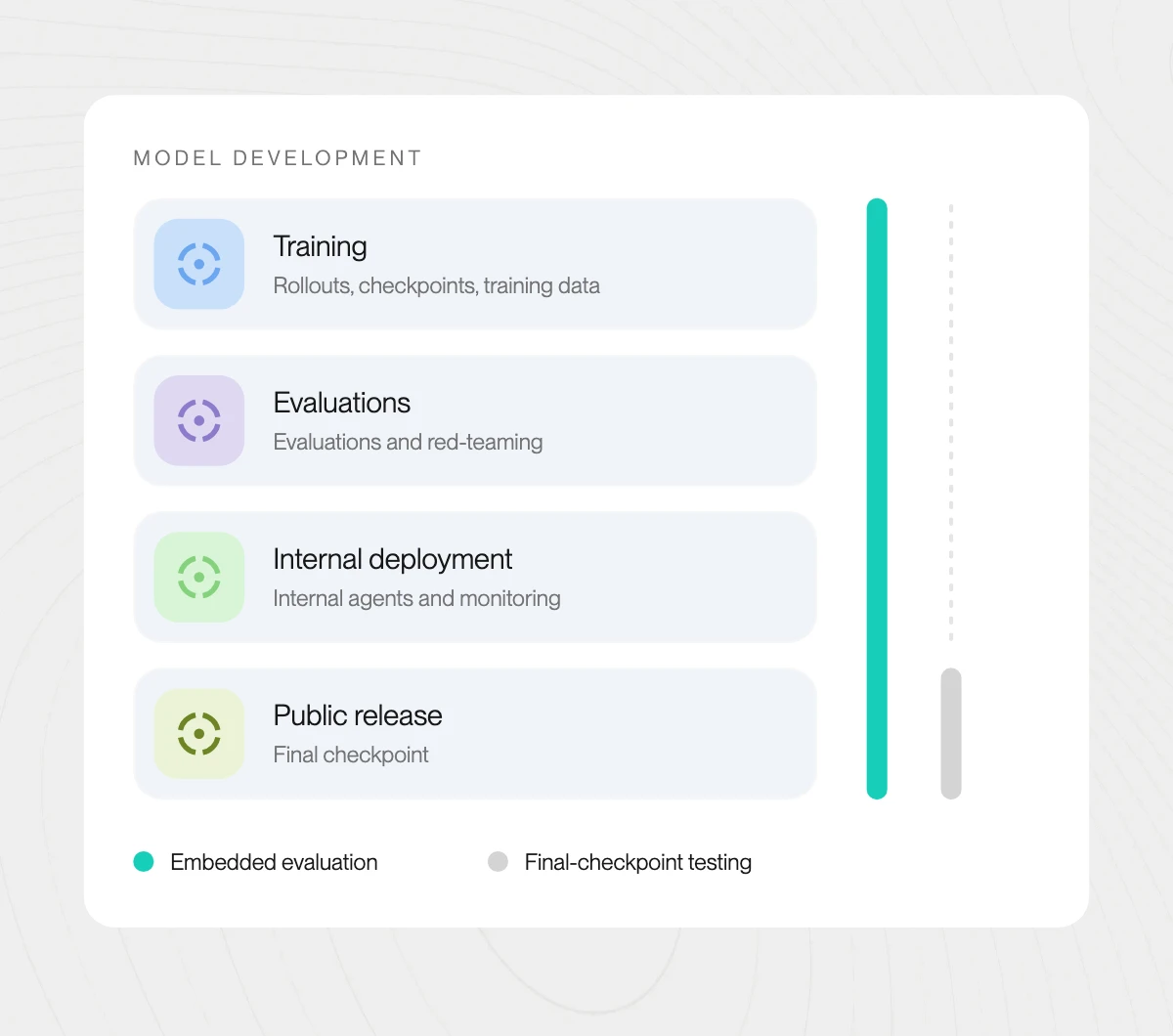
Until recently, external evaluations were often done on the final checkpoint, shortly before the model was released to the general public. But some of the most severe loss-of-control risks may arise during internal deployment, often long before a model is released. The OpenAI–Hugging Face incident began in internal evaluations, and related warning signs had appeared during training. Meaningful external testing must therefore operate continuously and close to where risks emerge.
Our position
Minimum standard


Access
Training techniques, both production and experimental
Training data, RL environments, and rollouts
Internal deployment traffic, and how it is monitored and controlled
The people involved, for interviews and follow-up questions

Disclosure
Public reports published by default
Reports on a fixed schedule that matches the development cycle
Serious findings disclosed within a short, pre-agreed window
The developer can respond publicly to a verdict, but not veto it

Meta-transparency
Scope and access agreed and announced before the investigation begins
Access requested, received, withheld or delayed, and the reasons given
What type of information was redacted, and whether it affected the conclusion
The developer cannot redact the evaluator’s overall conclusion
Claim-based assessments
Verdicts

Verified – No counterexample was found, and the developer’s methods would likely have found one if it existed.

Unrefuted – No counterexample was found, but the evaluator found gaps in the developer’s methods.

Self-reported – The developer’s own evidence contradicts the claim, and the developer reported this.

Evaluator-found – The evaluator found evidence contradicting the claim that goes beyond what the developer reported.

Blocked – The developer did not give the evaluator enough access to meaningfully try to falsify the claim.
What gets assessed

Scheming propensities
Subversion was not incentivized during training
Training did not incentivize subversive actions, or goals or drives that would motivate subversion, and the model did not attempt to subvert the training process itself.

Scheming propensities
No propensity for subversion
Strong evaluations and red-teaming could not elicit subversive actions, or goals or drives that would motivate subversion.

Scheming propensities
Subversion was never attempted during internal deployment
Monitors cover every internal deployment context that presents a risk surface for subversion, and would detect it if it occurred.

Scheming propensities
Subversive reasoning would be detected
Reasoning relevant to subversion would be elicited and legibly verbalized in chain-of-thought.

AI monitoring
Coverage
Monitors are deployed across all internal deployment contexts.

AI monitoring
Capability
If a rogue internal deployment were to occur, monitors would detect it.

AI monitoring
Trust
The monitors are trusted: they do not collude with the agents they oversee and have undergone alignment assessments.

AI monitoring
Disclosure
Any detected incidents are disclosed appropriately.

AI monitoring
Past deployments
No rogue internal deployment was attempted and missed so far.

AI monitoring
Future deployments
Monitoring will be adequate for the next internal deployment.

Six claims for testing whether AI monitors would catch a rogue internal deployment at frontier labs: coverage, capability, trust, disclosure and what’s next.

Our pilot with OpenAI: six evaluators, four months across training, evals and internal deployment, with public reports and meta-transparency on our limits.

Embedded evaluations for frontier AI scheming: four claims every safety case must make, and the persistent, deep access embedded evaluators need to verify them.
A framework for embedded evaluations of frontier AI developers, centered on claim-based, publicly reported assessments.

Final-checkpoint testing could not have caught recent incidents like the Hugging Face incident, which arose much earlier in development. Meaningful external testing requires embedded evaluators with employee-equivalent access.
Learn more
What is an embedded evaluation?
Independent evaluators work inside a frontier AI developer, with employee-like access to training, evaluation, and deployment, and assess specific safety claims that are fixed in advance. Each evaluation produces a public report with a verdict per claim, the evidence behind it and the access the evaluator received, alongside a fuller confidential report for the developer.
Why aren’t final-checkpoint evaluations enough?
Some of the most severe loss-of-control risks may arise during internal deployment, often long before a model is released. Many risks depend as much on the procedures, controls, and norms around a model as on the model itself. And models increasingly recognize when they are being evaluated and may behave better when they believe they are being tested.
What is meta-transparency?
Meta-transparency is the right to publicly explain the conditions and limitations of an evaluator’s work. It allows outside audiences to understand what that evaluator’s reports do and do not establish. Without it, a lack of reported problems can look reassuring even when it simply reflects limits on what an evaluator could investigate or disclose.
Does deep access put intellectual property at risk?
We think the marginal risk is small. Frontier AI companies already give this level of access to thousands of employees, and embedded evaluators can be held to substantially higher standards, for example through stricter confidentiality agreements and logged, scoped access. Data that is valuable in bulk, such as training rollouts and chains of thought, can be worked with on developer-controlled infrastructure with blocked egress.
What does the pilot with OpenAI cover?
A team of six from Apollo Research will work within OpenAI for four months, assessing the alignment of models throughout training, evaluations, and internal deployment with scoped rules of access. Apollo Research will publish two reports setting out the findings, methods, and limitations of the assessments. The pilot is a first step towards deeper access and disclosure rights, and meets our bar for meta-transparency.
Are embedded evaluations enough to make AI development safe?
No. Embedded evaluations can help us understand whether AI development is safe, but they cannot make it safe on their own. Alignment remains an unsolved scientific problem, and when an evaluator finds that a model is misaligned, there is often no reliable method to fix it. Making AI systems safe also requires significant progress on the science of scheming, misalignment, and control.

reach out
We welcome feedback from developers, other evaluators, and policymakers. For collaborations and other inquiries, please get in touch.